The Latvian company Valsts nekustamie īpašumi (VNĪ), a state-owned and stock exchange listed enterprise, is responsible for managing and developing public real estate assets across Latvia. In colder climate zones such as Latvia, the heating and warm water needs add up to more than 50% of total energy use. The freezing period can start as early as late October and last until April. This challenging environment requires special attention – an example: rain gutters are heated to keep roofs free of ice and snow.
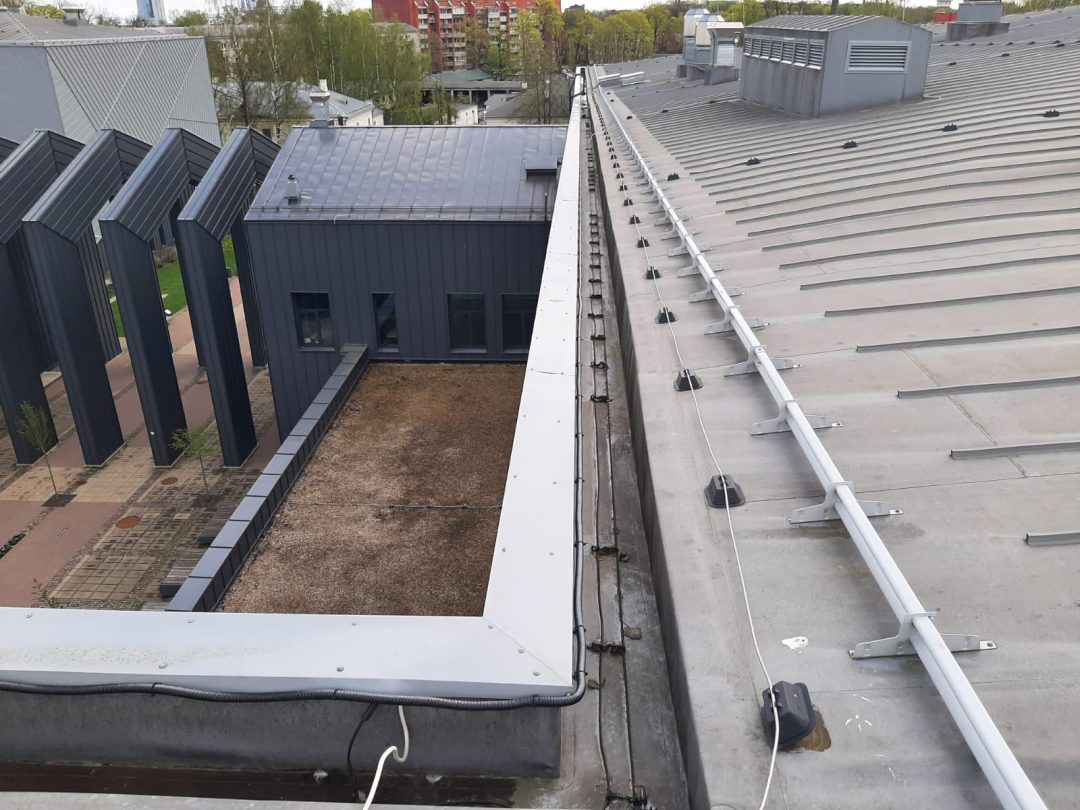
A team of three Energy Scouts, Anete Dzene, Ronalds Briņķis and Eduards Vācietis identified significant energy saving potential in the operation of roof drainage heating cable systems, that span more than 3.2 km across a public museum complex, which is a VNĪ-managed property. The Energy Scouts discovered these systems had been operating on factory default settings, running continuously throughout the winter season without adapting to real-time environmental conditions such as temperature and humidity. As a result, they were consuming excessive electricity, generating unnecessary CO₂ emissions, and increasing operational costs.
Such inefficiencies in heating cable systems are not an isolated issue – they are common across Latvia and many other countries with colder climates, where long and harsh winters require reliable roof drainage heating. However, outdated or unoptimized settings often cause systems to run for far longer than necessary, wasting both energy and money.
By analyzing one facility and its heating cable control unit, the team quickly discovered that simple configuration changes could lead to dramatic improvements. By adjusting the system to operate based on local weather data, they optimized its performance—reducing the number of operational cycles and ensuring heating cables were only active when truly necessary. The impact was immediate: potential energy savings of 101.54 MWh per heating season, CO₂ reductions of 11.88 tons annually, and nearly €8,718 in cost savings—all achieved without any additional investment and providing instant payback from day one.
Encouraged by these results, the team proposed rolling out the solution across other VNĪ properties. Their forward-looking concept involves creating a centralized database of heating systems and implementing digital monitoring tools to oversee performance and enable proactive adjustments. This would not only ensure optimal energy usage but also improve maintenance processes and extend the overall lifespan of the systems. The project highlights how thoughtful process optimization – driven by awareness and linking of data – can produce substantial environmental and financial benefits with minimal effort. It also offers a scalable, practical solution for other organizations facing similar challenges in cold-weather regions across Europe. The potential is immense, the VNĪ alone manages 3.7 million m² of building space.
Process optimisation
Standby Consumption
- Industry Sector: Real estate property management
- Energy source: Electrical energy
- Energy savings potential: 101.5 MWh (heating season October-April)
- CO2 savings potential: 11.88 tons CO2/year
- Potential cost reduction: 8,718 €/year
- Investment costs: 0 €
- Payback period: 0 years
- Company:
SJSC “State Real Estate” (VAS “Valsts nekustamie īpašumi”)
Talejas iela 1, Rīga LV-1026
Latvia
https://www.vni.lv/