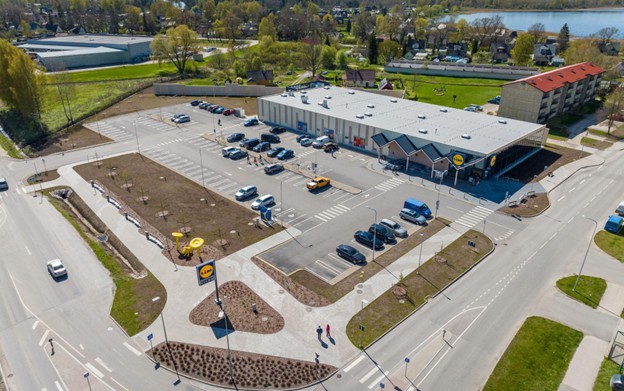
Lidl is an international player in the retail sector, operating nearly 13,000 stores in Europe and the United States and reaching a revenue of € 132 billion. Also in Estonia Lidl is growing with up to date 22 stores across 10 different cities with three distinct building types. With a total retail area typically spanning 1,400 m² per site, the energy footprint of the stores is significant. As part of the Young Energy Europe (YEE) program, LIDL’s Energy Scouts Roger Linask and Kristo Allikas have focused their efforts on a Võru-based facility to prove that modern refrigeration can do more than just keep food cold – it can power the building’s climate control.
The Problem: The Invisible Loss of Thermal Energy
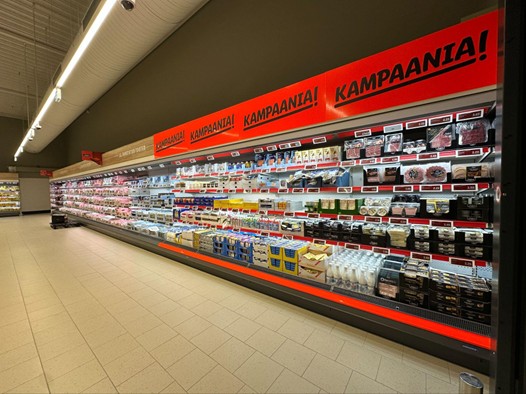
In a standard retail environment, the refrigeration system is a 24/7 engine. While it successfully maintains the “cold chain” for perishable goods, it simultaneously generates a massive amount of residual heat as a byproduct of the cooling process.
- The Status Quo: Currently, this residual heat is rejected directly into the atmosphere, totally unused.
- High Costs: To keep the 1,400 m² store warm for customers, the facility relies on a combination of district, gas and electrical heating, of which electrical heating is covering the majority workload.
- Environmental Impact: This dependency leads to high operational costs and elevated CO₂ emissions that could be avoided if the “waste” energy were captured.
The Solution: Closing the Loop with Heat Recovery
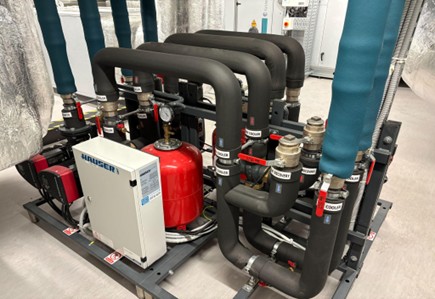
The Energy Scouts’ project aims to capture this rejected thermal energy and redirect it into the store’s space heating circuit. By repurposing the energy before it reaches the rooftop dry coolers, the system improves its overall Coefficient of Performance (COP).
To transform this concept into a functional reality, the two Energy Scouts identified four critical technical upgrades:
- Pump Station Logic Update: The control software must be reprogrammed to prioritize the heat recovery loop as the primary thermal destination before any energy is sent to the outdoor coolers.
- Valve Commissioning: Manual “Heat Recovery” ball valves must be converted to automated actuators to allow the system to respond to heating demands in real-time.
- Insulation Audit: Existing lines must be inspected for high-grade thermal insulation to ensure heat is not lost in transit between the compressor room and the sales floor.
- Pump Optimization: Adjusting the variable speed drive (VSD) settings on the existing pumps to manage the increased head pressure of the new recovery circuit.
Impact and Future Scalability
The potential for this project is immense. By displacement of expensive utilities, the project is projected to save over 100 MWh of energy annually. This translates to a reduction of 41 tons of CO₂ emissions per year for a single store. The Young Energy Europe project has highlighted the vital importance of data collection in pinpointing these opportunities. With a projected payback period of well below two years, this solution is not only financially sound, but also environmentally responsible. Once the pilot store is optimized, the model can be adapted across the 22-store network, significantly reducing the carbon footprint of retail in Estonia. The project team convinced the jury with this scalable approach and won third place in the national competition.
Heat Recovery
Heating
- Industry sector: Retail
- Energy source: Waste Heat reduces demand for district heating and electricity
- Energy savings potential:
- 42 MWh electricity per year
- 61 MWh from district heating
- CO2savings potential:
- 25,7 t CO₂/year from electricity savings
- 15,3 t CO₂/year from district heating savings
- Payback period: 1,79 years
- Company:
Lidl Estonia OÜ
A. H. Tammsaare tee 47
11316 Tallinn
Estonia