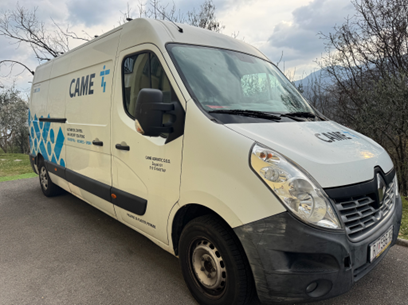
CAME Adriatic d.o.o., headquartered in Kastav, was founded in 2011 as part of the multinational CAME Group. The company provides residential, commercial, and urban solutions for automation, control, and surveillance across Croatia and the wider region. Primarily a wholesaler, CAME Adriatic also offers project engineering services. Its offerings include the design, engineering, installation, and maintenance of parking systems and access control solutions for larger-scale projects like hotels, hospitals, sports stadiums, public parking facilities, and retail environments.
CAME Adriatic consumes 164 MWh of energy annually, of which 77% is attributable to fuel consumption. In 2024, total emissions amounted to 39 t CO₂e, including 33 t CO₂e from Scope 1 emissions (fuel consumption) and 6 t CO₂e from Scope 2 emissions (electricity consumption in buildings). Energy costs account for approximately 3% of total material costs. The company’s headquarters with 12 employees consumes electricity from the grid, while its most significant environmental impact stems from the vehicle fleet used by engineers and service teams for field operations. The fleet consists of four service vans and three passenger vehicles, which collectively travel more than 150,000 km and consume 12,481 liters of diesel per year.
To identify appropriate decarbonization measures, Energy Scouts Stella and Sandra Hrvatin conducted a scenario analysis assessing the impact of solar photovoltaic installation and fleet electrification on capital expenditure (CAPEX), operating expenditure (OPEX), GHG emissions, and return on investment. Their finding: a fully electric fleet was deemed not financially feasible at this stage. Instead, the company has decided to transition to a mixed fleet of electric and hybrid vehicles, fuelled mainly by a PV-System on their roof.
So over the next 10 years, the following measures will be implemented as part of the transition:
- Procurement of electricity certified as originating from renewable sources
- Planning and installation of photovoltaic panels on the CAME Adriatic’s roof
- Installation of EV charging stations in the CAME Adriatic’s parking area
- Gradual replacement of the existing fleet with electric and hybrid vehicles
The investment of 130,000 € covers photovoltaic panels, EV charging stations, and the price difference between conventional internal combustion engine vehicles and their electric or hybrid counterparts. Following the implementation of these measures, total energy consumption is expected to decrease by 39%, while Scope 1 and Scope 2 GHG emissions are projected to be reduced by 87%. In addition, annual energy-related costs are expected to decrease by approximately EUR 16,000. This leads to an amortization time of 8.1 years – rather long, but the pv-system is expected to deliver energy for 25+ years.
Implementation
The decarbonization plan has been developed for the 10-year period from 2025 to 2035, and the transition is currently underway. One car was replaced with a hybrid alternative in 2025, and in March 2026, CAME Adriatic applied for a 40% grant from the Environmental Protection and Energy Efficiency Fund to support the procurement of an electric service van. The company has also begun developing the technical documentation for a photovoltaic system on the headquarters’ roof. Meanwhile, the finance department is identifying potential financing sources for both the PV system and EV charging stations. The transition will be gradual, with fleet replacement occurring as vehicles reach the end of their service life and depend on the availability of co-financing sources. The full environmental benefits of these measures will become apparent only once the transition is complete.
Challenges
Currently available EV options and the existing regional EV infrastructure do not fully support CAME Adriatic’s business model. Service teams must cover long distances in short periods to provide time-sensitive maintenance services to customers. Additionally, the ability to visit multiple locations in a single day is critical. For these reasons, hybrid vehicles are currently more suitable than fully battery-electric vehicles. But as the electric vehicle market is very dynamic, the attractiveness of electric mobility solutions grows fast, especially combined with electricity from pv.
Mobility
Photovoltaics
- Industry sector: Mechanical engineering / project engineering
- Energy source: switch from diesel to electricity
- Energy savings potential: 12,481 liter Diesel
- CO2 savings potential: 33 t CO2e/year
- Potential cost reduction: 16,000 €
- Investment costs: 130,000 €
- Payback period: 8.1 years
- Company:
Came Adriatic d.o.o.
Žegoti 6/1
51215 Kastav
www.came.com